The average UK driver travels about 20 miles a day, something modern 2026 electric vehicles can easily handle. But for many homeowners, the bigger question isn’t range; it’s the cost of charging.
With petrol prices fluctuating and electricity rates rising, many people wonder if a typical UK solar setup can realistically power an EV.
According to EV Infrastructure News, EV drivers can save up to £1,400 a year compared to petrol when charging at home. With solar panels generating your own electricity, a large portion of that charging cost can drop close to zero.
However, making it work efficiently involves understanding your car’s energy use, the UK’s seasonal sunlight patterns, and the smart tools that connect your solar system with your EV charger.
In this guide, we break down the exact math of solar-to-EV charging, the hidden technical rules you need to know, and the smartest financial strategies for 2026.
Can You Charge an Electric Car with Solar Panels at Home?
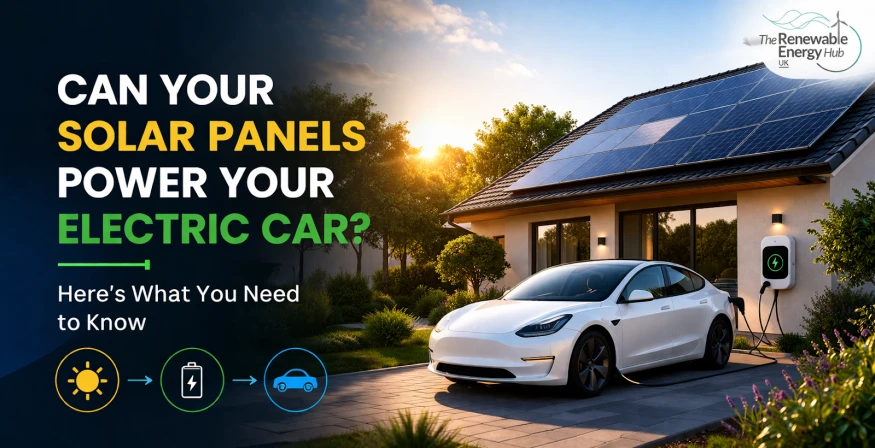
Yes, you can charge an electric car using solar panels installed at home. However, the setup needs a few key components: a compatible EV charger, enough solar panel capacity to meet your vehicle’s energy demand, and ideally a home battery to store excess power generated during the day.
For many UK homeowners, combining solar panels, an electric vehicle, and battery storage can significantly reduce both driving and household electricity costs.
Solar panels generate electricity mainly during daylight hours, between 8 AM and 5 PM, depending on the season. However, most EV owners plug in their cars during the evening after returning home, when solar generation has already stopped.
The main challenge is timing. Solar panels generate power during the day, while most EVs are charged in the evening. Using smart charging or a home battery can help bridge this gap.
How Solar EV Charging Actually Works
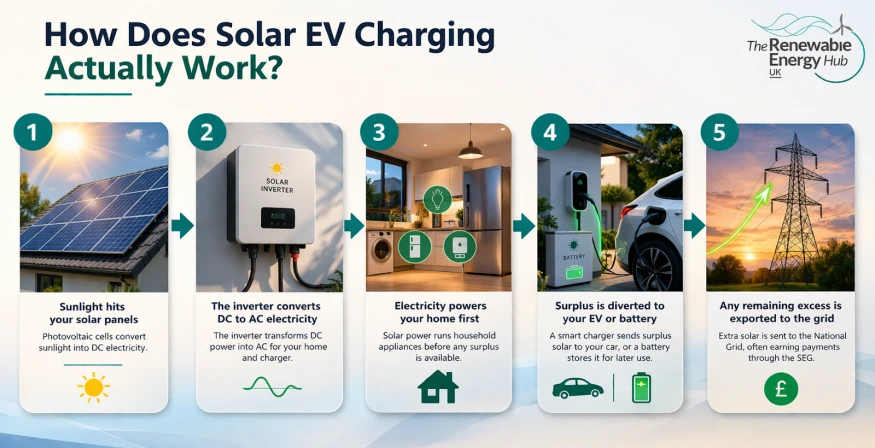
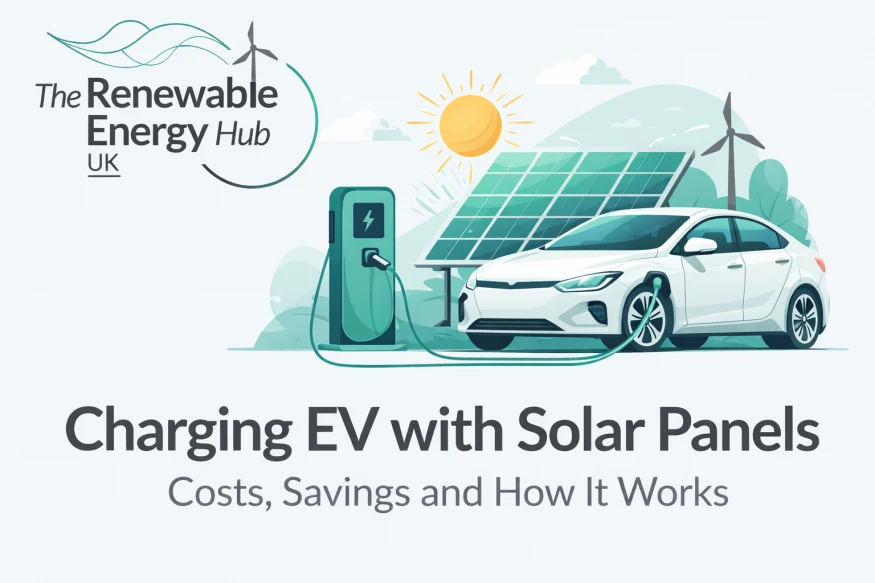
Charging an EV with solar power is fairly simple. Solar panels generate electricity during the day, which can power your home and charge your electric car when it is plugged in. Here is the basic process:
- Sunlight hits the panels and produces DC electricity.
- The inverter converts DC power into AC electricity used by your home and EV charger.
- Solar energy powers household appliances before anything else.
- If there is surplus electricity, it can be used to charge your electric car.
- If solar power isn’t enough, the grid supplies the remaining electricity.
- Some EV chargers adjust charging speed to match the solar energy available.
How to Charge Your EV if Your Home Already Has Solar Panels
If your home already has solar panels, you can use that energy to charge your EV. The main factor is when you plug in your car.
If you charge during the day
- Your panels are generating electricity while the sun is out.
- If the EV is plugged in, it can use that solar power directly.
- A solar-compatible smart charger can send any extra solar energy straight to your car.
If you charge in the evening
- Most people plug in their EV after work.
- By then, solar panels had stopped producing electricity.
- Without a home battery, charging will mainly use grid power.
Quick tip: A solar-compatible EV charger helps ensure your car uses as much solar energy as possible instead of relying on the grid.
How Much Solar Power Does an EV Actually Need?
A typical UK electric car can be powered by around 7–8 solar panels over the course of a year. However, most homeowners install 10–14 panels so the system can support both EV charging and household electricity use.
Most households installing solar for the first time aim for a 10 to 14-panel system (roughly 4 to 5.5kWp). This covers a meaningful portion of both household electricity use and EV charging, rather than sizing for just one or the other.
However, solar panels don't generate evenly throughout the day or across the year. Most UK solar generation happens between late spring and early autumn, and peaks in the middle of the day.
If you're charging your car at 7 pm after work, you are not directly using midday solar, unless you have a battery to store it first.
|
|
|
|
|
|
|
|
|
|
|
|
|
|
|
|
|
|
|
|
|
|
|
|
|
Practical example: A 40 kWh EV battery, like the one in a Nissan Leaf, paired with a 4 kWp solar system, could take around 10 hours of good summer sunshine to fully charge. In winter, when solar output is lower, the same charge would take longer and may need some support from the grid.
Factors That Affect How Much Solar You Can Generate
- Roof orientation: South-facing roofs produce the most, east/west around 15–20% less, and north-facing roofs are generally unsuitable.
- Shading: Even partial shading from trees, chimneys, or neighbouring buildings can reduce output significantly.
- Panel efficiency: Modern premium panels (400W+) generate more per square metre than older models.
- Season: UK solar output is highest from April to September and considerably lower from October to February.
- Inverter quality: A well-matched inverter is important for overall system efficiency.
Do You Need a Battery to Charge Your EV with Solar?
No, you don’t need a battery to charge your EV using solar panels, but it can make the setup much more practical.
Without a battery, your EV can only use solar power while the sun is shining and when your panels are producing more electricity than your home needs. For many households, this window is quite limited.
With a home battery, any extra solar energy generated during the day is stored and can be used later, including when you plug in your car at night. Some systems even let you decide whether the stored energy should power the home first or charge the EV.
What Size Battery Do You Need?
The right battery size depends on your solar output, daily driving needs, and how much electricity your home uses at night.
Many installers commonly recommend a 10–15 kWh battery paired with a 4–6 kWp solar system for households looking to power both their home and EV. A larger system costs more upfront but can allow you to run your home and charge your car mostly on solar energy for much of the year.
Do You Need a Special EV Charger for Solar?
No, a special charger isn’t required to charge your EV at home. However, a solar-compatible smart charger helps you use more of your solar energy.
A standard EV charger simply draws electricity from your home supply, whether it comes from solar panels or the grid. A solar-aware charger, however, detects surplus solar generation and sends that extra energy to your car instead of exporting it to the grid.
Common Charging Modes
Most solar-compatible chargers offer three simple modes:
- Fast Mode: Charges the car quickly using grid power if needed.
- Eco Mode: Uses solar power first and adds grid electricity if required.
- Eco+ Mode: Charges only with surplus solar energy, so charging may slow down or pause when solar output drops.
Good to know: Many solar chargers start charging only when there is enough surplus solar power (around 1.4 kW) to avoid pulling electricity from the grid unnecessarily.
Should You Charge Your EV with Solar or a Cheap Overnight Tariff?
Many people assume charging an EV with solar power is always the cheapest option. In reality, it depends on your electricity tariff and solar export rate.
If your energy provider offers a cheap overnight EV tariff, it can sometimes be cheaper to export your solar power during the day and charge your EV at night.
For example, if you export solar energy at 15p per kWh but can charge your EV overnight at 7p per kWh, it may be more cost-effective to sell the solar power and charge your car later using the cheaper tariff.
A practical approach many homeowners use:
- Use solar power during the day for household appliances.
- Store excess solar energy in a home battery if you have one.
- Charge your EV overnight using a low-cost off-peak tariff if available.
- Export any remaining surplus solar electricity to the grid.
Pros and Cons of Charging Your EV with Solar
|
|
|
|
|
|
|
|
|
|
|
|
|
|
|
|
|
|
Which Setup Is Right for You? Common UK Scenarios
The right combination of equipment depends heavily on your home, your car, and your routine. Here are some common homeowner scenarios and what tends to work well:
Work-from-Home Drivers (Car at Home During the Day)
A solar-diverting smart charger can work very well in this situation. Since the car is parked at home during daylight hours, it can charge directly using peak solar generation without necessarily needing a battery.
Commuters Who Charge Overnight
For drivers who typically charge in the evening or overnight, a home battery becomes important. Without storage, most evening charging will rely on grid electricity instead of the solar energy generated during the day.
Low Daily Mileage (Under 30 Miles)
If your daily driving is relatively low, a modest 3–4 kWp solar system can often cover most of your EV charging needs across the brighter months, particularly from spring through autumn.
Higher Daily Mileage (Over 60 Miles)
Drivers with longer daily journeys will need a larger solar system (around 5 kWp or more) along with a larger battery (around 10–15 kWh) to significantly offset EV charging costs.
Homes That Already Have Solar Panels
If you already have solar installed, the easiest upgrade is usually switching to a solar-compatible EV charger. Adding a battery later can allow you to store solar energy for overnight charging.
Planning a Full Solar + EV Setup
If you are starting from scratch, designing the solar panels, battery, and smart charger together creates the most efficient system. Getting quotes from MCS-certified installers will help ensure the setup is properly sized and compliant.
What Does Solar EV Charging Cost — and How Much Can You Save?
Costs vary widely depending on your property, system size, and installer. We have included indicative ranges below, but always request quotes specific to your home:
|
|
|
|
|
|
|
|
|
|
|
|
|
|
|
|
|
|
|
|
Important: These are indicative ranges only. Actual costs depend on your property, existing electrical setup, local installer pricing, and chosen equipment.
How Much Can You Save by Charging Your EV with Solar?
Your savings depend on how much solar power your system generates, how often you charge your EV at home, and your electricity tariff. However, a few general benchmarks can give a rough idea:
- A typical 4 kWp solar system can save UK households around £400 per year on electricity bills (Energy Saving Trust estimate).
- If you charge your EV mainly using solar energy, running costs can drop to about 1–2p per mile.
- Charging from grid electricity usually costs around 4–8p per mile, while petrol or diesel cars often cost 12–20p per mile.
- A home setup combining solar panels, battery storage, and EV charging can potentially save £700 or more per year compared to relying heavily on public charging.
What Is Vehicle-to-Grid (V2G) and How Could It Affect Solar EV Charging?
Vehicle-to-Grid (V2G) is a technology that allows electricity to flow both ways between your electric car and your home. Instead of only charging the car, the EV battery can also send power back to the house or even to the electricity grid.
What this means for homeowners:
- Your EV could act like a large backup battery for your home.
- Solar energy generated during the day could be stored in the car and used later.
- In some cases, excess electricity could even be sent back to the grid.
Current situation in the UK
- V2G is still in the early stages and not widely available yet.
- It often requires special bidirectional chargers and compatible EVs.
What most homeowners do today
- For now, a home battery system is the more common and practical way to store solar energy for later EV charging.
Will Solar EV Charging Work in Winter?
Yes, but it works less efficiently than in summer.
Solar panels still generate electricity during winter, even on cloudy days. They do not require direct sunlight and can produce power from daylight alone. However, shorter days, a lower sun angle, and frequent cloud cover in UK winters mean solar output can drop by around 50–70% compared with summer months.
In practical terms, this means:
- Your solar panels will still generate electricity in winter, but in smaller amounts.
- You will likely use more grid electricity for EV charging between October and February.
- If you have a home battery, you can store the solar energy produced during the day and use it later.
- Combining solar with a smart overnight tariff can help keep charging costs low during the winter months.
In short, solar EV charging still works in winter, but it usually becomes part of a mixed approach, with solar covering some of your energy and the grid making up the rest.
What If I Don't Have Solar Panels Yet?
If you don’t have solar panels yet, planning your solar system and EV charger together can make things easier and more efficient. Designing the setup as one system helps ensure all components work smoothly together.
When discussing options with an installer, consider these key points:
- System size: Choose enough solar capacity to support both your home’s electricity use and EV charging.
- Battery storage: Decide whether to install a battery now or prepare the system so one can be added later.
- Charger compatibility: Make sure the EV charger works well with your solar inverter and supports solar charging.
- Export payments: Register for the Smart Export Guarantee (SEG) to earn money from surplus electricity sent to the grid.
- Future upgrades: Ask about systems that can support technologies like vehicle-to-grid (V2G) later.
Ready to Explore Your Options?
The Renewable Energy Hub provides free, impartial advice and connects UK homeowners with MCS-certified installers without any sales pressure. Find out what's possible for your home. No hard sell. No spam. Just honest guidance and vetted professionals.
Contact Renewable Energy Hub and Compare Local Installers at No Fees