
Heat pumps are no longer a niche technology, they’re becoming a mainstream choice for UK homes. In fact, according to the Heat Pump Association, heat pump sales in the UK rose by 63% in 2024, showing just how quickly homeowners are moving toward low-carbon heating.
But while most people compare brands, prices and installation costs, very few look at what actually powers the system, the refrigerant. This single factor quietly determines how efficient your heat pump is, how eco-friendly it will be, and how future-proof your investment really is.
In this guide, we’ll break down the key differences between R32 and R290, compare them across safety, efficiency and environmental impact, and help you choose the right option for your home with confidence.
What Is a Heat Pump Refrigerant?
A heat pump refrigerant is the working fluid that absorbs, transfers and releases heat within the system. It is central to how a heat pump delivers efficient heating and cooling.
How refrigerants work inside a heat pump
A heat pump doesn’t generate heat in the traditional sense. Instead, it transfers heat using a continuous refrigerant cycle. The refrigerant absorbs heat from the outside air, even at low temperatures, then passes through a compressor where its temperature increases.
This heated refrigerant then releases heat inside your home, creating an efficient and consistent heating process.
Why they are essential for heating and cooling
The refrigerant plays a direct role in how efficiently the system operates. It affects how well heat is transferred, which in turn influences overall system efficiency, heating output and energy consumption. A well-chosen refrigerant ensures stable performance, optimised energy use and lower running costs over time.
This highlights why the type of refrigerant you choose directly affects how efficiently and sustainably your system performs.
Why Refrigerant Choice Matters
Different refrigerants vary in efficiency, environmental impact and safety characteristics. These differences directly affect performance, cost and long-term suitability.
Impact on efficiency and running costs
The efficiency of a heat pump depends heavily on how well the refrigerant transfers heat. A more efficient refrigerant allows the system to achieve the same output with less energy.
This can lead to:
- Lower electricity usage
- Improved system performance
- Reduced long-term heating costs
Environmental impact (GWP explained simply)
Global Warming Potential (GWP) measures how much a refrigerant contributes to climate change if released.
- High GWP → greater environmental harm
- Low GWP → more sustainable
For example, R290 has an extremely low GWP compared to R32, making it a more environmentally responsible option.
Safety considerations in modern systems
Refrigerants are classified based on flammability, which affects system design and installation.
- R32 → mildly flammable
- R290 → more flammable but tightly regulated
Modern heat pumps are engineered with safety mechanisms, so both can be used safely when installed correctly.
These factors set the context for understanding the main refrigerants used today and how they compare in real-world applications.
Types of Refrigerants Used in Heat Pumps
Most modern heat pumps rely on a small set of refrigerants, each with distinct trade-offs in efficiency, environmental impact and regulatory compliance.
R410A – The older refrigerant being phased out
R410A was once the backbone of heat pump and air conditioning systems, but its relevance is rapidly declining. The primary reason is its very high Global Warming Potential (GWP), exceeding 2000, which makes it one of the least environmentally friendly options still in use.
With tightening regulations across the UK, particularly under F-Gas policies, R410A is being systematically phased out.
As a result, it is now rarely used in new installations and is increasingly seen as outdated technology that homeowners should avoid when considering future-ready systems.
R32 – The current industry standard
R32 has become the current standard for modern heat pumps, offering a strong balance between efficiency, environmental impact and practicality. It delivers reliable thermal performance while operating with a significantly lower GWP than older refrigerants like R410A, making it a more responsible choice in today’s regulatory environment.
Its widespread adoption across the UK also makes it easier to source, install and maintain, which reduces both installation complexity and servicing challenges.
However, despite these advantages, R32 is still considered a transitional solution, as the industry gradually moves toward refrigerants with even lower environmental impact.
R290 (Propane) – The low-carbon, future-ready option
R290, commonly known as propane, represents the direction the industry is heading. As a natural refrigerant, it offers an extremely low GWP of around 3, making it one of the most environmentally responsible options available today.
Beyond sustainability, R290 also delivers strong real-world performance, particularly in heating applications where efficiency matters most.
Its growing adoption across the UK reflects the industry’s shift toward low-GWP, regulation-ready solutions. Increasingly, manufacturers are designing new systems specifically around R290, positioning it as a future-ready solution for homeowners who want both performance and sustainability.
With a clear understanding of these refrigerants, comparing R32 and R290 highlights the differences that matter most in practice.
R32 vs R290: Safety, Environmental Impact and Efficiency Compared
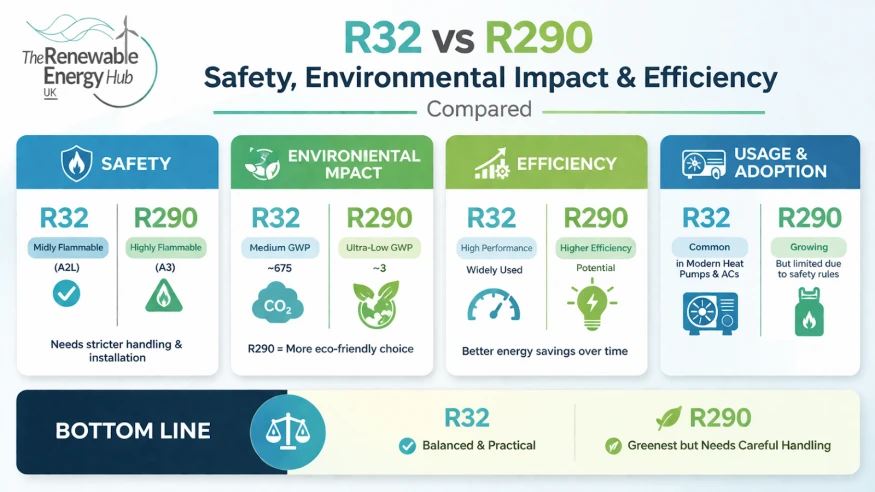
R32 and R290 are currently the most relevant refrigerants for residential heat pumps, and comparing them side by side helps clarify their strengths and trade-offs.
|
|
|
|
|
|
|
|
|
|
|
|
|
|
|
|
|
|
|
|
|
|
|
|
Environmental impact comparison
R290 has a clear advantage when it comes to environmental performance. With a GWP of around 3, its impact is almost negligible compared to R32, which sits around 675.
This difference becomes significant under UK F-Gas regulations, where lower-GWP refrigerants are prioritised, making R290 a far more future-proof and regulation-aligned choice.
Safety comparison
R32 is classified as A2L (mildly flammable), making it easier to handle and install in standard residential setups. R290, on the other hand, is A3 (highly flammable), requiring stricter safety protocols, controlled charge limits and proper ventilation.
However, modern R290 systems are engineered with sealed components and safety mechanisms, ensuring safe operation when installed correctly.
Efficiency comparison
Both R32 and R290 offer high efficiency, but their performance differs in real-world conditions. R290 typically delivers better thermodynamic efficiency, especially in heating mode and lower outdoor temperatures.
This translates into improved COP and more stable output, making it particularly effective for consistent heating in colder UK climates.
Installation and system design differences
R32 systems are simpler to install and widely supported by most installers, making them more accessible for quick adoption. R290 systems require specialised handling due to flammability constraints, including stricter installation standards.
However, these systems are often optimised for performance, offering better long-term efficiency and alignment with evolving regulatory requirements.
Once the technical differences are clear, the next step is identifying which option best fits your home and priorities.
R32 vs R290: Which Should You Choose for Your Home?
The right choice depends on installation conditions, budget and how much you prioritise long-term sustainability.
When R32 is the better choice
R32 is often the more practical option for homeowners who prioritise availability and ease of installation. It is widely supported across the UK, meaning most installers are familiar with it and systems are easier to source.
This typically results in quicker installations and fewer design constraints. It also tends to involve a lower upfront investment compared to newer technologies.
R32 may be more suitable if:
- You want a widely available and proven system
- Installation simplicity and speed are important
- You are working within a fixed or limited budget
For many households, R32 offers a reliable balance between performance, cost and accessibility.
When R290 is the better choice
R290 is better suited for homeowners who are thinking long-term and want to invest in a system aligned with future energy standards.
Its extremely low environmental impact makes it ideal for those prioritising sustainability, while its strong real-world efficiency can deliver better performance over time. It is particularly well-suited for new installations where systems can be designed specifically around it.
R290 is ideal if:
- You want a future-proof, low-carbon solution
- Sustainability and environmental impact are key priorities
- You are installing a new, high-performance system
While it may require more planning, it offers stronger long-term value.
Factors to consider before making your decision
Choosing between R32 and R290 is not just about specifications, it depends on how well the system fits your home and long-term goals. Key factors like property type, space availability and installer expertise can influence which option works best.
Before deciding, consider:
- Property size and layout, which affects system design and efficiency
- Available installation space, especially for outdoor units
- Installer expertise, particularly for R290 systems
- Long-term efficiency versus upfront cost, to balance investment and savings
Many homeowners use platforms like Renewable Energy Hub to compare qualified installers and find systems that are tailored to their specific requirements.
Beyond individual preferences, regulations and industry trends are shaping how refrigerants will be used in the coming years.
The Future of Heat Pump Refrigerants in the UK
The UK is moving toward low-carbon heating solutions, and refrigerants play a critical role in meeting environmental targets and regulatory requirements.
Understanding F-Gas regulations and phase-down targets
F-Gas regulations are a key driver behind the shift in refrigerant choices across the UK. These policies aim to gradually reduce the use of high-GWP refrigerants by limiting their availability and encouraging alternatives with lower environmental impact.
As the phase-down progresses, systems using higher-GWP refrigerants are becoming less viable, both from a compliance and cost perspective.
Why the UK is shifting toward low-GWP refrigerants
The transition toward low-GWP refrigerants is closely tied to the UK’s broader net-zero targets. Heating accounts for a significant portion of household emissions, and reducing the environmental impact of heat pumps is essential.
Refrigerants like R290 support this shift by offering minimal climate impact while maintaining strong performance, making them a logical step forward for sustainable heating.
What this means for new installations and upgrades
For homeowners, these regulatory changes directly influence long-term decisions. Choosing a low-GWP refrigerant today is not just about sustainability, it’s about avoiding future limitations and additional costs.
Systems built around environmentally compliant refrigerants are more likely to remain viable for years without needing major upgrades or replacements.
This means:
- Long-term regulatory compliance without future restrictions
- Lower overall environmental impact from day one
- Reduced risk of costly system changes as regulations tighten
Taking these factors into account helps ensure your investment remains efficient, compliant and future-ready.
As these changes influence homeowner decisions, a few common questions often arise when comparing refrigerants and choosing the right system.
Need Help Choosing the Right Heat Pump?
The performance of a heat pump depends just as much on system design and installation as it does on refrigerant choice.
Compare Trusted Local Installers
Not all installers offer the same level of experience, especially with newer refrigerants like R290. Comparing verified professionals helps you assess expertise, system recommendations and pricing, reducing the risk of poor installation and performance issues.
Get Expert Advice Tailored to Your Home
Every home has different heating requirements. A tailored assessment ensures your system is correctly sized and configured, avoiding inefficiencies, higher running costs and uneven heating performance.
Find the Right Balance of Efficiency, Safety and Cost
A well-chosen system considers more than upfront cost. Balancing efficiency, safety standards and long-term savings ensures your heat pump performs reliably while staying compliant with future regulations.
With these insights, the differences between refrigerants become clear and easier to evaluate.
Conclusion
Choosing the right heat pump refrigerant is no longer a minor detail, it directly impacts efficiency, environmental performance and system longevity. While R32 remains a practical and widely available option, it is ultimately transitional.
R290 stands out as the greener, more future-proof choice, offering lower emissions and stronger real-world performance. The shift is clear; low-GWP refrigerants are becoming the standard.
If you’re planning a heat pump installation, Renewable Energy Hub helps you compare trusted installers and make the right choice with confidence